Emerging Technologies Shaping the Future: AI, Machine Learning and Quantum Computing
Introduction
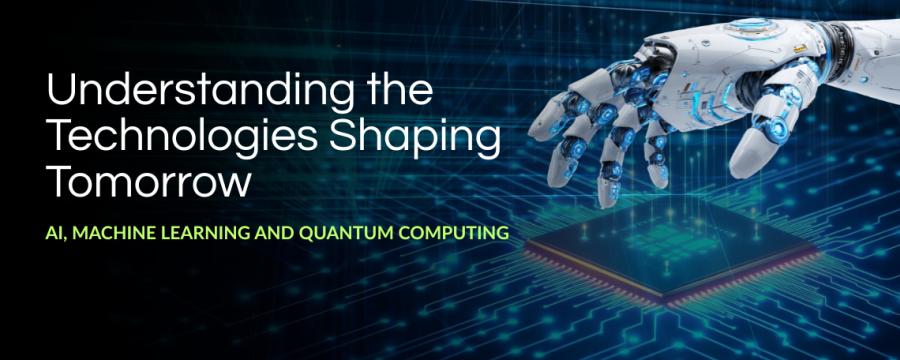
Artificial Intelligence (AI), Machine Learning (ML) and Quantum Computing are transforming Computer Science and how industries approach data, automation and complex problem-solving. AI enables machines to perform tasks that typically require human intelligence, ML allows systems to learn from data, and Quantum Computing explores a fundamentally different approach to computation.
For students aspiring to build careers in Computer Science, understanding how these technologies work, where they are applied and what skills they require is the first step towards exploring opportunities in the evolving digital landscape.
What Is Artificial Intelligence (AI)? Applications and Uses
Artificial Intelligence refers to the development of computer systems that can perform tasks commonly associated with human intelligence. These include understanding language, recognising images, identifying patterns, solving problems and supporting decision-making.
AI is already influencing several industries:
- Healthcare: Supporting medical image analysis, clinical decision support and healthcare research.
- Education: Enabling personalised learning experiences, intelligent tutoring systems and automated assessment support.
- Finance: Assisting with fraud detection, risk analysis and customer service.
- Manufacturing: Supporting quality inspection, predictive maintenance and process optimisation.
- Transportation: Contributing to driver-assistance systems, route planning and autonomous vehicle research.
One of the most visible developments in recent years has been Generative AI. These systems can produce text, images, audio, video and computer code based on user instructions. They are changing how people approach creative work, research and problem-solving.
However, AI is not simply about making machines perform tasks independently. It also involves addressing important questions around data privacy, fairness, transparency, reliability and responsible use. As AI becomes more widely adopted, professionals must understand both its capabilities and its limitations.
What Is Machine Learning? Types, Applications and Examples
Machine Learning is a branch of Artificial Intelligence that enables computer systems to learn from data and improve their performance without being explicitly programmed for every possible situation.
Instead of following only a fixed set of instructions, an ML model identifies patterns in information and uses them to make predictions or decisions.
Consider an online shopping platform. By analysing a customer's browsing history, previous purchases and product preferences, a Machine Learning system can recommend products that may be relevant to them. Similarly, email services use ML models to identify spam, while financial institutions use them to detect unusual transaction patterns.
Machine Learning is generally explored through three major approaches:
| Approach | How it works | Example |
|---|---|---|
| Supervised Learning | Learns from labelled datasets containing known outcomes. | Predicting house prices using historical data. |
| Unsupervised Learning | Identifies patterns and groupings in data without predefined labels. | Grouping customers based on purchasing behaviour. |
| Reinforcement Learning | Learns through interactions, feedback and rewards. | Training an agent to navigate a simulated environment. |
Machine Learning has become an important part of data science, automation, intelligent applications and predictive analytics. Its development also depends on strong foundations in programming, statistics, mathematics and data handling.
What Is Quantum Computing? Concepts and Applications
While AI and Machine Learning are transforming how conventional computers process information, Quantum Computing is exploring an entirely different way of performing calculations.
Traditional computers use bits, which represent information as either 0 or 1. Quantum computers use quantum bits, known as qubits. Through principles of quantum mechanics, qubits can exist in a combination of states called superposition. They can also become connected through a phenomenon known as entanglement. These properties allow quantum computers to approach certain computational problems differently from classical machines.
To understand the fundamentals, consider three important concepts:
- Superposition: A qubit can exist in a combination of the 0 and 1 states until it is measured. This allows quantum systems to represent information in ways that classical bits cannot.
- Entanglement: Two or more qubits can become correlated, meaning their states are connected and cannot always be described independently.
- Quantum interference: Quantum states can interact in ways that increase the probability of certain outcomes while reducing others. Quantum algorithms use this property to guide computations towards useful results.
Applications of Quantum Computing Across Industries
Quantum Computing is still an evolving field, and practical applications at scale remain an area of research and development. However, it is being explored for problems involving:
- Drug discovery and healthcare research: Simulating molecular behaviour to support the study of complex chemical and biological systems.
- Material science: Modelling the properties of materials to explore new possibilities in energy, electronics and manufacturing.
- Financial modelling: Investigating optimisation and simulation techniques for complex financial systems.
- Logistics and optimisation: Exploring approaches to complex scheduling, routing and resource-allocation problems.
- Cryptography: Understanding how quantum algorithms could affect existing encryption methods and the development of quantum-resistant security.
It is important to understand that quantum computers are not designed to replace conventional computers in every situation. They are specialised systems being developed to address particular types of problems where quantum approaches may offer an advantage.
Difference Between AI, Machine Learning and Quantum Computing
Although these technologies have different foundations, they share an important purpose: expanding the possibilities of computation and problem-solving.
Artificial Intelligence is the broader field focused on developing systems that can perform tasks associated with human intelligence. Machine Learning is one of the approaches used to build AI systems by enabling them to learn from data. Quantum Computing introduces a different computational model that may eventually support certain complex calculations, including research into quantum approaches to Machine Learning.
| Technology | Primary focus | Key application areas |
|---|---|---|
| Artificial Intelligence | Enabling machines to perform intelligent tasks. | Intelligent assistants, image recognition and decision support. |
| Machine Learning | Learning patterns from data to make predictions or decisions. | Recommendation systems, fraud detection and predictive analysis. |
| Quantum Computing | Using quantum-mechanical principles to process information. | Molecular simulation, optimisation and quantum research. |
These fields may increasingly intersect. For example, researchers are exploring how quantum computing could support certain Machine Learning tasks, while AI is also being investigated as a tool for improving aspects of quantum hardware and system development. However, these applications are still developing and should not be mistaken for established, widespread capabilities.
Skills Required to Build a Career in AI and Machine Learning
Understanding emerging technologies requires more than familiarity with software or digital tools. Students need a strong foundation in Computer Science, analytical thinking and practical problem-solving.
- Programming and computational thinking: Languages such as Python are widely used in AI, Machine Learning and data science. Understanding programming logic helps students develop applications and work with algorithms.
- Mathematics and statistics: Concepts such as linear algebra, probability, calculus and statistics are important for understanding Machine Learning models and the mathematical foundations of computing.
- Data analysis and interpretation: Working with datasets, identifying patterns and evaluating results are essential skills for developing reliable intelligent systems.
- Algorithms and problem-solving: A sound understanding of algorithms, data structures and computational complexity helps students approach technical challenges systematically.
- Ethical and responsible technology development: As intelligent systems become more influential, professionals must consider data privacy, security, bias, transparency and the wider impact of technology.
Students interested in Quantum Computing can also begin exploring linear algebra, quantum mechanics, quantum circuits and introductory quantum programming. A strong foundation in mathematics and Computer Science provides a useful starting point.
Career Opportunities in AI, Machine Learning and Quantum Computing
The growth of AI, Machine Learning and advanced computing is creating opportunities across different areas of technology. The specific roles available depend on a person's qualifications, technical expertise and practical experience.
| AI Engineer | Developing and implementing AI-powered applications and systems. |
|---|---|
| Machine Learning Engineer | Building, training and evaluating Machine Learning models. |
| Data Scientist | Analysing complex datasets to identify patterns and support decision-making. |
| AI Researcher | Exploring new algorithms, models and approaches to intelligent computing. |
| Robotics Engineer | Developing robotic systems that combine software, sensors and intelligent control. |
| Quantum Computing Researcher | Studying quantum algorithms, quantum hardware and computational applications. |
These career paths can involve different educational requirements. While AI and Machine Learning roles often require strong programming and mathematical foundations, specialised Quantum Computing research may also require advanced study in physics, mathematics or related disciplines.
Explore Computer Science Programmes at S-VYASA Global City Campus
As emerging technologies continue to influence the digital world, Computer Science education must evolve alongside them. Students need opportunities to understand foundational concepts, explore new technologies and apply their knowledge to practical challenges.
At S-VYASA Deemed-to-be University, the School of Computer Science and Applications offers programmes across areas such as Artificial Intelligence, Machine Learning, Data Science, Robotics and related computing disciplines.
Students exploring these fields can consider programmes such as:
- M.Sc. Artificial Intelligence, Machine Learning and Data Science: An opportunity to develop knowledge in intelligent systems, data analysis and computational techniques.
- MCA in Artificial Intelligence and Data Science (IBM): Focuses on developing computing knowledge and skills relevant to intelligent applications and data-driven technologies.
- MCA in AI, Cyber Security and Blockchain (IBM): Brings together emerging areas of computing, digital security and decentralised technologies.
- MCA in AI, Machine Learning and Robotics (iHUB): Connects intelligent computing concepts with robotics and automation.
- BCA specialisations in Artificial Intelligence, Cyber Security and Blockchain: Introduces students to contemporary areas of computing and their practical applications.
Conclusion
Artificial Intelligence, Machine Learning and Quantum Computing represent different yet interconnected directions in the evolution of technology. While AI and Machine Learning are already influencing industries and everyday experiences, Quantum Computing is opening new possibilities for solving specialised computational problems.
For students entering the world of Computer Science, these developments offer an opportunity to look beyond conventional programming and explore the technologies shaping the future. Building strong fundamentals, developing practical skills and remaining curious about emerging innovations can help students prepare for a constantly evolving digital landscape.
The future of technology will not be shaped by those who simply use it, but by those who understand it, question it and develop what comes next.