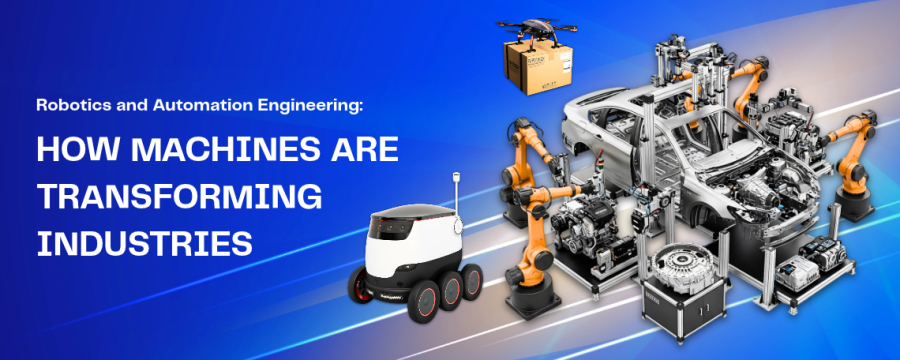
Robotics and Automation Engineering: How Machines Are Transforming Industries
Have you ever thought about how our world has developed over the past few decades? One of the major changes brought to the forefront through this development is the evolution of robotics and its deployment in the industrial sector, making industrial processes more efficient, faster and easier.
Think about the last parcel that landed at your door. Somewhere along its journey, a robotic arm probably picked it, a conveyor sorted it, and a software system may have decided the fastest route to your home. You never saw any of it, yet it happened in a matter of hours.
That quiet, behind-the-scenes efficiency is the work of robotics and automation engineering. It is no longer a futuristic idea from science fiction that we see in movies. It is already running factories, warehouses, hospitals and entire cities. And the people who design, build and maintain these systems are among the most sought-after engineers today.
If you are a student wondering where the future of engineering lies, this is a good place to start.
What Is Robotics and Automation Engineering?
At its heart, robotics and automation engineering is a branch of engineering that explores the techniques and technologies involved in teaching machines to do useful work, often faster, more safely and more precisely than people can. It sits at the meeting point of mechanical engineering, electronics, computer science and artificial intelligence.
As a robotics engineer, one might design the gripper on a robotic arm, write the code that lets it "see" through a camera, or build the control system that keeps it steady. Automation engineers take a wider view. They look at an entire process, whether it is an assembly line or a hospital pharmacy, and ask which parts can run on their own.
What makes this field exciting is that it is never just one skill. You learn to think like a designer, a programmer and a problem-solver, all at once.
Role of Robotics in Manufacturing and Industrial Automation
Being the field that requires the intervention of robotics and engineering the most, factories around the globe were among the first to welcome robots and associated technologies. If you walk into any major factory, you will see robotic arms welding car bodies, painting panels and fitting parts with millimetre-level accuracy, paving the way for a new system of operations known as industrial automation.
From its inception to the present day, industrial automation has evolved to go well beyond heavy lifting. Under the banner of Industry 4.0, machines are connected to sensors and software that can predict when a part will fail before it actually breaks. Collaborative robots, or "cobots", now work alongside human workers in environments designed to support safe collaboration, taking over repetitive, tiring tasks while people focus on quality and judgement
Applications of Robotics in Logistics and Warehousing
With the introduction of social media, smartphones and well-developed internet facilities, our world has seen a significant boom in online shopping, which, in turn, has transformed warehouses into some of the most automated spaces on the planet to meet the growing demand.
For example, autonomous mobile robots glide across floors, carrying shelves to packers. Automated sorting systems handle thousands of parcels an hour. Drones are being tested for inventory checks and last-mile delivery. Each of these systems requires engineers who can programme robot navigation, integrate sensors and keep everything running without a hitch. For a country with India's scale of e-commerce and quick-commerce, robotics in logistics is not a luxury. It is a necessity.
Applications of Robotics in Healthcare
The application of robotics is not limited to industries and factories; it has also progressively influenced and transformed our healthcare system. Perhaps we can say that one of the most inspiring applications of robotics is in healthcare. Surgical robots now help doctors perform minimally invasive procedures with greater precision, which often means smaller incisions and faster recovery for patients. Rehabilitation robots and artificial exoskeletons help people regain movement after strokes or injuries.
Beyond the operating theatre, automation is quietly transforming hospital operations. Robots are now being deployed in our hospitals and healthcare setups to disinfect rooms, deliver medicines between wards and run laboratory tests around the clock. During the pandemic, many hospitals discovered just how valuable these machines can be.
For S-VYASA, a university long rooted in holistic health and well-being, this is a natural meeting point. Engineering that serves human health is engineering with real purpose.
How Robotics and Automation Engineering Power Smart Systems
Whenever we think about robots and automation, the first image that comes to mind is that of metallic structures with mechanical arms, wheels, wires and so on. But, to be honest, some of the most powerful forms of automation are embedded in the systems we use every day. Smart traffic signals adjust to real-time congestion. Smart grids balance electricity supply and demand. Precision agriculture uses drones and sensors to tell farmers exactly when to water or fertilise their crops.
These smart systems combine robotics with the Internet of Things (IoT), artificial intelligence and embedded electronics. As India builds smarter cities and greener infrastructure, engineers who can connect the physical world with intelligent software will shape how we live.
Career Scope and Opportunities in Robotics Engineering in India
The scope of robotics engineering in India has widened dramatically. Graduates today find roles such as:
- Robotics engineer or robot programmer
- Automation and control systems engineer
- AI and machine vision engineer
- Embedded systems and IoT developer
- Research and development engineer in medical, automotive or aerospace robotics
Employers range from global manufacturers and logistics companies to healthcare technology firms and fast-growing startups. And because robotics is still evolving, there is plenty of room to innovate and even build your own venture.
Why Study Robotics and Automation Engineering at S-VYASA?
At the School of Engineering and Technology at S-VYASA Deemed-to-be University, students explore the exciting world of robotics and automation through programmes designed to bridge engineering fundamentals with real-world applications.
Here, students can choose from programmes built around these very applications:
- B.Tech. in Robotics and Automation – for students who want to master industrial robots, control systems and the automation that powers factories and warehouses.
- B.Tech. in Robotics and Artificial Intelligence – for those drawn to intelligent machines that can see, learn and make decisions, from surgical assistants to autonomous vehicles.
- M.Tech. in Industrial Automation and Robotics – for graduates and working engineers ready to specialise and lead automation projects in industry.
At S-VYASA, robotics goes beyond machines and mechanisms. It is about shaping minds that innovate, adapt and solve problems with purpose. By combining technical excellence with a holistic approach to education, the university nurtures engineers who bring together sharp thinking, focused minds and inner resilience to turn complex challenges into meaningful solutions.
The Future of Robotics and Automation Engineering
Robots may transform the way we work, but human ingenuity will always drive progress. From factories and hospitals to the cities of tomorrow, the future belongs to engineers who can bring together intelligent machines, innovative thinking and purposeful design.
If you have ever taken apart a gadget just to see how it works, or wondered how a self-driving car makes decisions, a career in robotics and automation engineering could be your calling.
Ready to build the future?
Explore the robotics and automation programmes at S-VYASA School of Engineering and Technology and take your first step today.