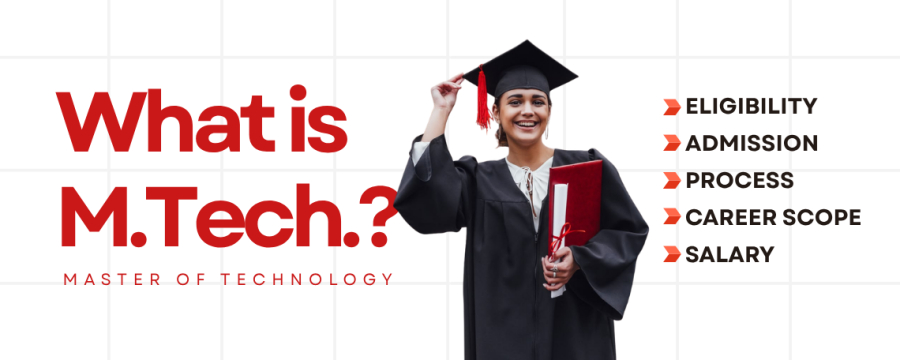
What Is M.Tech.? Eligibility, Admission Process, Career Scope & Salary
Key takeaways:
- M.Tech. runs for 2 years across 4 semesters, building on a related B.Tech. degree.
- Admission usually requires GATE, though some seats are available without it.
- Entry-level salaries in India typically range from 4 to 8 LPA, more in AI and data roles.
- Popular specialisations include CS Engineering, AI, Data Science, ECE, and Mechanical.
M.Tech. (Master of Technology), is a two-year postgraduate engineering degree that builds on a B.Tech.. It deepens technical specialisation and often includes a research project.
Introduction
A B.Tech. gives you breadth across an engineering discipline. An M.Tech. narrows that down.
The M.Tech. full form, Master of Technology, hints at the shift toward deeper, research-backed study. Whether you want a core engineering role or a research career, the degree sharpens one area instead of covering many.
Before you start your GATE exam preparation strategy, this guide covers eligibility, admission routes, and specialisations.
What is M.Tech.?
An M.Tech., or Master of Technology, is a postgraduate degree designed for students who want to deepen their expertise in a specific area of engineering or technology. Building on the foundation of a B.Tech. or equivalent qualification, the programme focuses on advanced technical concepts, specialised training, and research-oriented learning.
The M.Tech. course typically spans two years and is divided into four semesters. Along with classroom learning, students often work on projects, practical applications, and industry-relevant coursework. The final semester is usually dedicated to a dissertation, thesis, or major research project that allows students to apply their knowledge to real-world challenges.
Why Pursue an M.Tech. Degree?
An M.Tech. is a valuable choice for engineering graduates who want to develop advanced technical expertise and specialise in a particular domain. While a B.Tech. builds a strong foundation, an M.Tech. provides deeper knowledge, hands-on experience, and exposure to complex engineering challenges.
The degree can open doors to specialised roles in industries such as information technology, manufacturing, electronics, infrastructure, and emerging technology sectors. It is also highly regarded for positions involving innovation, product development, and technical leadership.
For students interested in research, development, or higher academic studies, an M.Tech. serves as a strong stepping stone. The programme equips graduates with the analytical and research skills needed for R&D careers and doctoral studies.
Eligibility Criteria for M.Tech. Admission
M.Tech. eligibility generally requires a B.Tech. or equivalent degree in a related discipline. Most universities also expect a minimum aggregate score, often around 50 to 60 per cent.
Some specialisations only accept candidates from closely related B.Tech. branches. Our [INTERNAL LINK: B.Tech. eligibility and career scope -> B.Tech. programme guide] covers which branches lead here most directly.
M.Tech. Admission Process in India
M.Tech. admission usually starts with an entrance exam score, followed by counselling or direct university applications. The mtech admission process can vary between government and private institutions.
Check M.Tech. fees early, since they differ sharply between government colleges and private universities. Some private institutions also offer management quota seats outside the standard process.
Entrance Exams for M.Tech. Admission
GATE is the primary entrance exam for M.Tech. admissions in many government-funded institutions, including IITs, NITs, and other leading engineering colleges. A strong GATE score can also improve access to scholarships, research opportunities, and recruitment by several Public Sector Undertakings (PSUs).
However, admission to an M.Tech. programme is not limited to GATE-qualified candidates. Many private universities, deemed institutions, and select engineering colleges offer M.Tech. admissions through their own entrance examinations, academic merit, or university-specific selection processes. This provides multiple pathways for students looking to pursue higher studies in engineering.
Popular M.Tech. Specialisations
M.Tech. specialisations span both core engineering and newer tech fields. Here’s a quick look at five common ones.
- M.Tech. in Computer Science Engineering
M.Tech. Computer Science Engineering covers advanced algorithms, systems, and software architecture. Graduates typically move into software engineering, research, or further academic work. - M.Tech. in Artificial Intelligence
M.Tech. Artificial Intelligence focuses on machine learning, neural networks, and applied AI systems. Mtech in AI and ML is one of the fastest-growing specialisations right now. - M.Tech. in Data Science
M.Tech. in Data Science blends statistics, programming, and large-scale data analysis. Demand here has grown steadily as industries lean more on data-driven decisions. - M.Tech. in Electronics and Communication Engineering
M.Tech. Electronics and Communication Engineering goes deeper into VLSI, signal processing, and communication systems. It suits students aiming for core electronics or research roles. - M.Tech. in Mechanical Engineering
M.Tech. Mechanical Engineering covers advanced design, thermal systems, and manufacturing. Many graduates move into core manufacturing, automotive, or research roles.
Subjects Covered in M.Tech. Programmes
Subjects Covered in M.Tech. Programmes
The subjects taught in an M.Tech. programme depend on the chosen specialisation, but most courses follow a similar academic structure. During the initial semesters, students focus on advanced core subjects that strengthen their technical knowledge and expertise in the selected engineering discipline.
As the programme progresses, greater emphasis is placed on specialised electives, practical applications, and industry-relevant learning. The final semesters typically involve a major research project, dissertation, or thesis, allowing students to apply their knowledge to real-world engineering challenges. Many institutions also offer elective choices aligned with industry trends and placement opportunities.
Career Opportunities After M.Tech.
M.Tech. career options vary by specialisation, but common paths include:
- Core engineering roles in manufacturing, electronics, or mechanical industries
- Software and AI roles for CS, AI, or Data Science graduates
- Research positions in academic or industry R&D labs
- PSU roles are often recruited directly through GATE scores
- Teaching at the undergraduate level
Knowing the M.Tech. full form doesn’t tell you which path suits you. The specialisation does. Some graduates pursue a [INTERNAL LINK: PhD eligibility after M.Tech. -> doctoral admission guide] afterwards, particularly those drawn to research over industry roles.
Salary After M.Tech. in India
M.Tech. salary depends heavily on specialisation and sector.
| Specialisation | Typical entry-level salary (India) |
|---|---|
| CS Engineering / AI / Data Science | 6 to 10 LPA |
| ECE | 4 to 7 LPA |
| Mechanical | 4 to 7 LPA |
M.Tech. salary in India climbs faster in AI and data-heavy roles than in traditional core branches, though core roles often offer more job stability.
Future Scope of M.Tech. in India
The future scope of an M.Tech. in India remains promising, driven by advancements in technology and innovation-led industries. High-growth areas such as artificial intelligence, data science, cybersecurity, robotics, and electronics continue to create strong demand for specialised engineering professionals.
Traditional branches like mechanical, civil, and electrical engineering also offer stable career opportunities, particularly in infrastructure, manufacturing, energy, and public sector organisations. As industries increasingly seek advanced technical expertise, M.Tech. graduates are well-positioned for leadership, research, and specialised engineering roles.
Final Thoughts – Is M.Tech. a Good Career Choice?
An M.Tech. is a valuable option for engineering graduates looking to build advanced technical expertise and strengthen their career prospects. The degree offers opportunities in specialised industry roles, research, innovation, and higher studies.
While career outcomes depend on factors such as skills, experience, and specialisation, an M.Tech. can provide a competitive advantage in a rapidly evolving job market. The M.Tech. full form may be Master of Technology, but the specialisation you choose can play a significant role in shaping your future career path.