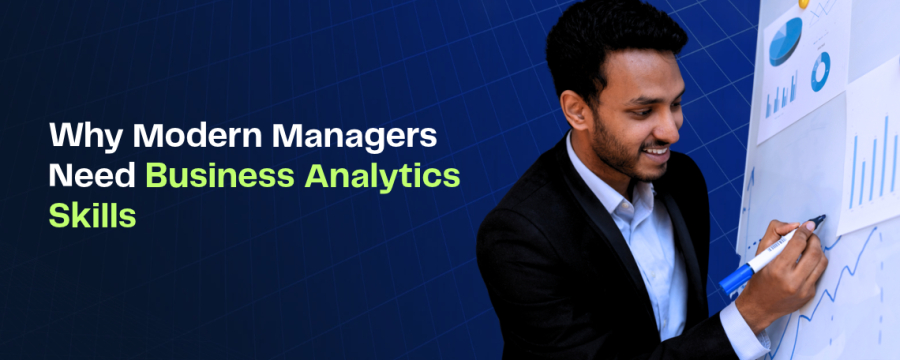
Why Modern Managers Need Business Analytics Skills
In a modern business environment driven by data, the ability to interpret information and make informed decisions is becoming one of the most valuable skills a manager can possess.
Businesses today generate enormous amounts of information through customer interactions, digital platforms, financial transactions, marketing campaigns and everyday operations. However, collecting data is only the beginning. The real value lies in understanding what it reveals and using those insights to make better business decisions.
This is where business analytics becomes essential. From identifying customer preferences and evaluating financial performance to improving operational efficiency and planning business strategies, analytics is transforming the way organisations function.
That is why understanding business analytics is no longer just an added advantage for modern managers; it is an increasingly important professional skill.
How Business Analytics Supports Data-Driven Decision-Making
Decision-making has always been at the heart of management. However, traditional approaches often relied heavily on experience, intuition and historical practices. While these continue to have their place, today's complex business environment requires managers to support their decisions with relevant information.
Business analytics enables managers to examine data, identify patterns, understand trends and evaluate possible outcomes before making important decisions.For instance, a retail manager can analyse purchasing patterns to determine which products are performing well, while a business development manager can study market trends to identify potential growth opportunities.
Instead of relying solely on assumptions, managers can use measurable insights to assess situations and make more informed choices.This ability to combine professional judgement with analytical thinking helps managers approach challenges with greater clarity and confidence.
How Marketing Analytics Helps Understand Customer Behaviour
Marketing has evolved significantly with the growth of digital platforms and online consumer interactions. Businesses now have access to valuable information about customer preferences, purchasing behaviour, engagement patterns and campaign performance.
Marketing analytics helps managers understand this information and translate it into effective marketing strategies.
For example, analysing website traffic, social media engagement and conversion rates can help businesses understand which campaigns are attracting customers and which require improvement. Similarly, customer segmentation allows organisations to develop more relevant marketing approaches for different audiences.
Managers with analytical skills can:
- Identify changing consumer preferences and market trends.
- Evaluate the performance of marketing campaigns.
- Understand customer acquisition and retention patterns.
- Allocate marketing budgets more effectively.
- Develop targeted strategies based on customer behaviour.
Students exploring these career paths can build relevant business foundations through the BBA in Digital Marketing and Business Analytics and the MBA Pro in Marketing, Finance and Business Analytics at S-VYASA Deemed-to-be University.
How Financial Analytics Improves Business Performance
Financial decisions influence almost every aspect of an organisation, from daily operations and resource allocation to long-term investments and expansion plans.
Business analytics allows managers to understand financial information beyond basic reports and statements. By examining revenue patterns, expenditure, profitability, cash flow and financial forecasts, they can develop a clearer picture of an organisation's financial position.
For example, a manager can compare departmental expenditure against budgets, identify areas of unnecessary spending and assess the financial implications of proposed investments.
Financial analytics also supports:
- Budget planning and financial forecasting.
- Revenue and profitability analysis.
- Cost management and resource allocation.
- Risk identification and assessment.
- Performance measurement through financial indicators.
For students interested in developing expertise across finance and business management, programmes such as the BBA in International Business, Digital Marketing and Business Analytics, the B.Com. in International Accounting Integrated with ACCA and the MBA Dual Specialisation in Finance and Business Analytics offer relevant academic pathways.
How Business Analytics Improves Operational Efficiency
An organisation's success depends not only on its business strategy but also on how efficiently its everyday operations are managed.Business analytics helps managers identify inefficiencies, monitor performance and improve processes across different departments.
Consider a company managing a large supply chain. Delays in transportation, inventory shortages and fluctuations in demand can affect both operational costs and customer satisfaction. By analysing historical sales data, inventory levels and delivery timelines, managers can anticipate potential challenges and make timely adjustments.
Similarly, analytics can help businesses improve workforce planning, production schedules, procurement and service delivery.
Some important applications include:
- Supply chain and inventory optimisation.
- Demand forecasting and resource planning.
- Process monitoring and performance evaluation.
- Workforce productivity analysis.
- Identification of operational bottlenecks.
The BBA in Aviation, Logistics and Supply Chain Management, MBA Pro in Logistics and Supply Chain Management and MBA Pro in Digital Business Management and Data Analytics at S-VYASA provide academic pathways aligned with these evolving business requirements.
Role of AI and Predictive Analytics in Modern Business Management
Artificial Intelligence (AI), machine learning and predictive analytics are changing how organisations process information and approach business challenges.
Today, businesses use intelligent systems to forecast demand, analyse customer behaviour, automate repetitive tasks and identify potential risks. These technologies are creating new possibilities across marketing, finance, human resources and operations.
However, technology alone cannot drive meaningful business outcomes. Organisations also need managers who understand how to interpret analytical findings, evaluate their relevance and translate them into practical strategies.
Modern managers must therefore develop an understanding of:
- Artificial Intelligence and its business applications.
- Predictive analytics and forecasting.
- Data visualisation and interpretation.
- Business intelligence tools and reporting systems.
- Ethical data usage and responsible decision-making.
The MBA Pro in Artificial Intelligence and Data Analytics at S-VYASA is particularly relevant to students seeking to explore the intersection of management, emerging technologies and data-driven business strategies.
Business Analytics Skills and Career Opportunities for Managers
As organisations increasingly integrate analytics into their business processes, employers are looking for professionals who can combine management knowledge with analytical capabilities.
A manager who understands data can contribute to strategic planning, identify opportunities for improvement and communicate business performance more effectively. These capabilities are valuable across a wide range of professional roles, including business analysts, marketing managers, financial analysts, operations managers and business development professionals.
Beyond professional applications, analytical thinking encourages managers to approach challenges with a structured and objective mindset. It enables them to question assumptions, evaluate alternatives and consider the long-term implications of their decisions, making them better equipped to navigate an increasingly complex business environment.
Developing Future-Ready Management Professionals at S-VYASA
At S-VYASA Deemed-to-be University, management education is designed to help students understand the changing dynamics of the business world and prepare for emerging professional opportunities.
Through its School of Management and Commerce, S-VYASA offers programmes covering diverse areas of business, including marketing, finance, digital business management, business analytics, data analytics, international business and supply chain management.
As businesses continue to evolve, the ability to interpret information, recognise patterns and translate insights into effective strategies is becoming increasingly important. While technology provides access to vast amounts of data, the real value lies in understanding what the numbers reveal and using those insights to make sound decisions, drive innovation and create meaningful business impact.
Explore Management Programmes at S-VYASA
Ready to build the skills that tomorrow's business world demands? Explore the management programmes offered by the School of Management and Commerce at S-VYASA Deemed-to-be University and take the first step towards a future in business and management.