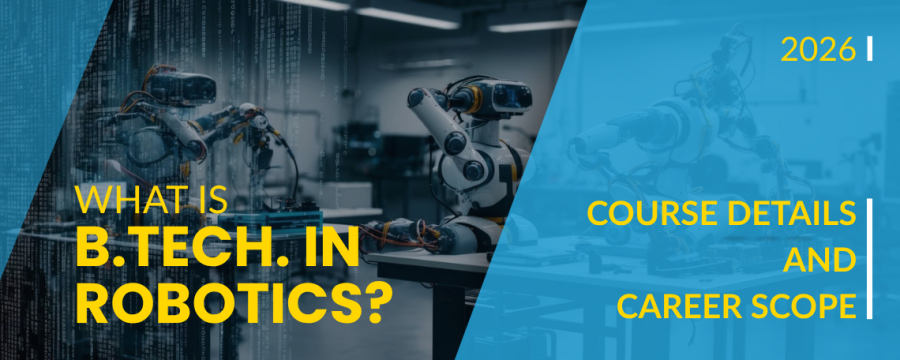
What Is B.Tech in Robotics? Course Details & Career Scope
Key takeaways:
- The course covers mechanics, electronics, and programming across 8 semesters.
- Tools like ROS, MATLAB, and Arduino are used hands-on, not just studied in theory.
- Entry-level salaries in India typically range from 3.5 to 6.5 LPA.
- Career paths span automation, manufacturing, defence, and AI-driven product companies.
B.Tech in Robotics trains students to design, build, and program machines that sense, move, and make decisions. Robotics engineering blends mechanical, electronics, and computer science fundamentals into one branch.
Introduction
When most people hear the word robotics, they picture robotic arms assembling cars on a factory floor. While that's still an important part of the field, robotics today goes much further.
From warehouse automation robots and delivery drones to surgical assistants and self-driving systems, robots are becoming part of everyday life. Behind these innovations are robotics engineers who design, build, and program intelligent machines capable of performing tasks with minimal human intervention.
So, what is a B.Tech in Robotics? Simply put, it's an interdisciplinary engineering programme that combines mechanical engineering, electronics, and computer science. Students learn how machines move, sense their surroundings, process information, and make decisions.
What is B.Tech in Robotics?
B.Tech in Robotics is a four-year undergraduate degree focused on building intelligent machines. So what does engineering actually mean in robotics? It’s the study of how a machine senses its environment, decides what to do, and acts on it.
Think of a robotic arm on an assembly line. It uses sensors to detect its surroundings, a controller to process information, and motors to execute precise movements.
That’s the whole field in miniature.
Why Choose Robotics Engineering in 2026?
The growing demand for robotics engineers is driven by the rapid adoption of automation across industries such as manufacturing, healthcare, logistics, and agriculture. Organisations are increasingly using intelligent systems to improve efficiency and productivity.
A major advantage of robotics engineering is its practical, hands-on nature. Students don't just learn theories; they design, build, and program machines that can perform real-world tasks. Seeing a robot you've created come to life can be incredibly rewarding.
With automation expanding across sectors, career opportunities continue to grow. Students who gain practical experience through projects and internships can build a strong foundation for success in this evolving field.
B.Tech Robotics Course Overview
A B.Tech in Robotics is a four-year undergraduate programme divided into eight semesters. The first two years focus on core engineering fundamentals, including mathematics, programming, electronics, and mechanics. From the third year onwards, students begin exploring specialised robotics subjects and elective courses that align with their interests and career goals.
Most robotics courses in India combine mechanical design, electronics, and coding rather than treating them as separate tracks. Robotics programmes at leading institutions also include lab sessions with actual hardware rather than relying only on simulations. When comparing engineering colleges for robotics, check for project-based learning. S-VYASA’s Global City Campus is NAAC A+ accredited and UGC-recognised and pairs core robotics courses with industry-aligned project work.
Eligibility Criteria for B.Tech in Robotics
The engineering eligibility route into robotics follows the standard pattern, with entry through one of three paths:
- JEE Main: Rank-based admission is used by many engineering colleges.
- CUET: a centralised option accepted by several deemed and central universities.
- Direct admission: based on Class 12 marks, common for private and deemed universities
Most robotics courses after 12th require Physics, Chemistry, and Mathematics at the Class 12 level. That baseline holds regardless of which entry route you take.
Subjects in B.Tech Robotics Engineering
Each robotics subject builds on the last, moving from basic mechanics toward intelligent control. Early subjects cover engineering mathematics, mechanics, and basic electronics.
From the second year, things get specific:
- Sensors and actuators
- Microcontrollers and embedded systems
- Control systems and kinematics
- Computer vision and AI basics
- Robot programming
- Mechanical design (CAD)
Some semesters also include manufacturing processes, since robotics engineers often need to understand how parts are actually made.
Tools and Software Used in Robotics Engineering
This is where robotics differs from most other engineering branches. Students don't just study theory—they work with the same tools used by robotics companies and research labs.
- ROS (Robot Operating System): for coordinating sensors, motors, and decision-making.
- MATLAB and Simulink: for modelling and testing control systems.
- SolidWorks: for mechanical design and part modelling.
- Arduino and Raspberry Pi: for hands-on prototyping.
- Python: widely used for robot programming and AI integration.
Getting comfortable with these tools early genuinely matters. Recruiters often ask about project work, not just grades.
Career Opportunities After B.Tech in Robotics
An engineering job built around robotics isn’t confined to factory floors. Graduates typically move into:
- Automation and manufacturing companies
- Defence and aerospace firms
- Healthcare robotics and medical device companies
- Agricultural technology and drone startups
- AI and software companies building robotic products
Some graduates also go on to research roles, particularly with an M.Tech in robotics or automation. Not every role involves hardware. Many robotics engineers end up writing more software than expected.
Salary After B.Tech Robotics in India
Pay varies by city, company, and how hands-on your project experience is.
| Experience level | Typical engineering salary in robotics roles (India) |
|---|---|
| Fresher (0-1 yr) | 3.5 to 6.5 LPA |
| 2-4 years | 6.5 to 11 LPA |
| 5+ years / specialised (AI, controls) | 12 to 20 LPA+ |
Salary growth in robotics is typically strong for graduates with hands-on project experience and industry internships. For those with strong project portfolios. A B.Tech robotics salary at a product company often beats a similar role at a traditional manufacturer.
Future Scope of Robotics Engineering in India
The scope of engineering in robotics makes sense to question, given how fast automation is moving. Short answer: it’s expanding, not shrinking.
Warehouse automation, defence robotics, and surgical robotics are all growing areas. Demand for engineers who combine hardware and AI skills keeps rising. That combination, not just core mechanics, is where the future scope sits.
Final Thoughts - Is Robotics Engineering a Good Career Choice?
B.Tech Robotics is an excellent choice for students who enjoy innovation, problem-solving, and building intelligent systems that interact with the real world. The programme equips students with interdisciplinary skills across mechanical engineering, electronics, artificial intelligence, and computer science, preparing them for careers in rapidly evolving industries.
As automation, artificial intelligence, and smart technologies continue to reshape sectors such as manufacturing, healthcare, logistics, and agriculture, the demand for robotics professionals is expected to grow steadily. With access to the right labs, projects, internships, and industry exposure, students can develop the practical expertise needed to succeed in this future-focused field.
For those excited by technology and innovation, robotics engineering offers the opportunity to build solutions that can transform the way people live and work.